 Site index page




 Dance Factory is paradoxically one of the smallest games ever on PS2 - it all has
to fit in memory, which explains the simple background graphics, though those
build up as you play and respond to the beat, unlike simpler light-synthesisers,
and had to be chosen to provide variety without overwhelming the display of
arrows, scores and key information needed to play the game. Graphics also have to
compete for memory with the dance database - the library of varying-length dance
step sequences, customised for each tempo and time signature - and the CD analysis.
Dance Factory is paradoxically one of the smallest games ever on PS2 - it all has
to fit in memory, which explains the simple background graphics, though those
build up as you play and respond to the beat, unlike simpler light-synthesisers,
and had to be chosen to provide variety without overwhelming the display of
arrows, scores and key information needed to play the game. Graphics also have to
compete for memory with the dance database - the library of varying-length dance
step sequences, customised for each tempo and time signature - and the CD analysis.


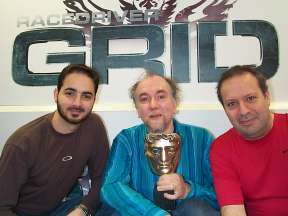 Since random access to spiral-recorded optical discs is not much faster on PS3
and Xbox360 than it was on the previous generation - or older CD consoles, for that
matter - it's harder to justify nowadays, especially when games like GRID also stream
high-resolution graphics from the disc as they run. But with eight-layer interactive
music and a vast speech database, any phrase of which could be triggered at any time,
GRID could not fit all the main game audio into RAM even on a half-gig console, and
so CMStream introduced reams of extra code to bring streaming up to scratch on new
game systems. This time I was assisted by two other experienced audio programmers,
recruited from companies spun off from the former EMI Central R&D labs - Aristotel
Digenis and Pete Goodwin (no relation).
Since random access to spiral-recorded optical discs is not much faster on PS3
and Xbox360 than it was on the previous generation - or older CD consoles, for that
matter - it's harder to justify nowadays, especially when games like GRID also stream
high-resolution graphics from the disc as they run. But with eight-layer interactive
music and a vast speech database, any phrase of which could be triggered at any time,
GRID could not fit all the main game audio into RAM even on a half-gig console, and
so CMStream introduced reams of extra code to bring streaming up to scratch on new
game systems. This time I was assisted by two other experienced audio programmers,
recruited from companies spun off from the former EMI Central R&D labs - Aristotel
Digenis and Pete Goodwin (no relation).

DiRT2 brings practical 3D loudspeaker audio capabilities out of the lab and into the homes of over a million gamers, but this is just the start - impressive though DiRT2 audio is, you ain't heard nothing yet! Codemasters is collaborating with the biggest names in the games industry, and other respected organisations like the AES and BBC, to develop game audio from a junior partner of the music and movie industries to a leader and exemplar.
With games now turning over more cash at retail and online than either music or home cinema, and arguably the primary source of HD audio and video worldwide, we have reached a tipping point where innovation in games can lead the way to truly immersive audio. Surround sound in cinema is a luxury, often erratically used. Gamers deserve better - for them it can be a matter of life and death!
Formula One 2010, PS3/Xbox360/PC, Codemasters 2010
 In 2009 Codemasters signed up the rights to develop games based on the Formula One world championship, and our Birmingham Studio was assigned the task of developing this game for the current lead platforms, building on the tech used in DiRT and GRID. The main technical advances in F1 2010 are the use of granular synthesis for non-player car sounds as well as the player's engine, and an elaborate reflection system prototyped by Rob Pattenden and production-engineered by Hugh Lowry, which models the intricate echos and pass-by sounds as cars and listeners move around the circuit. Ambisonic soundfields are again extensively used in the game and in the paddock, ensuring that the game makes best use of 7.1 surround sound on PC and PS3 - in two or three dimensions - without compromise to the mono, stereo and 5.1 channel surround mixes. Custom HRTF options in the Rapture3D OpenAL driver optimise the surround-sound experience for PC players who prefer to listen on headphones.
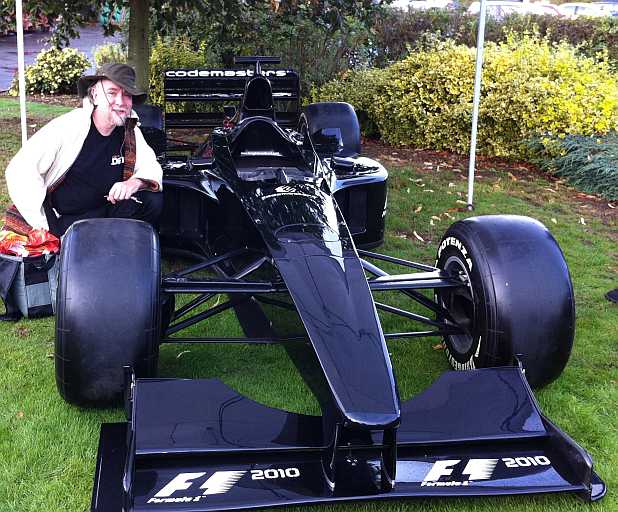 All the sound design and much of the audio programming for F1 was done at our Southam HQ, by the team responsible for DiRT2 - the Central Tech Audio posse of myself, Aristotel Digenis and Pete Goodwin, plus game audio programmer Adam Sawkins - assisted by new hires Lars Hammer and Andy Morris at the former Rage/Swordfish studio in Birmingham. Sound design drew on the skills of Andrew Grier, Mark Knight, Jon Newman, Stephen Root, Dave Sullivan, Ed Walker, Pete Ward and Claire Woodcock, making this the biggest audio project yet to emerge from Codemasters.
The game went straight to number one in the UK all platform games charts in the week of release! It subsequently earned our team a second BAFTA for best sports game of the year
Formula One 2011, PS3/Xbox360/PC, Codemasters 2011
Follow-up F1 2011 built on the same NeSound custom audio tech with more input from the Birmingham posse, including greater use of stereo sounds in the front end and full Ambisonic soundfields for the paddock and garage ambiences, terminal damage effects, loading and other transitions including scenes after qualifying and each race. These fourteen custom soundfields are rendered in mono, stereo, 2D or 3D on PS3 (via HDMI and 3D7.1 speakers) and in that layout and many others, and on headphones with HRTF modelling, on PC through Blur Ripple's Rapture3D OpenAL driver which was again bundled with the game.As well as these premade soundfields all the platforms use Ambisonic mixing for around 130 individually-positioned voices, hybrid third-order on PS3, first-order on Xbox and up to fourth order on PC depending upon hardware spec. The mandatory switch from XAudio to XAudio2 required some minor trimming on XBox360 but additional parametric equalisation - based on code I'd written for Silicon Studio decades before - helped improve the quality of the engine sounds on all platforms.
The 3D 7.1 mix on PS3 was tweaked slightly, applying the 'tilt' suggested following Audio Engineering Society reviews of the scheme, to make the front and rear triangles parallel with walls rather than floor and ceiling. The difference is subtle and within the variability of playing postures, but improves compatibility with 5.1 cinema surround mixes. It's the layout shown in figure 6 of my AES paper..
Bodycount and Operation Flashpoint, PS3/Xbox360/PC, Codemasters 2010..2011
Shooters! Bodycount was the first Codemasters combat game with audio in 3D on PS3, using my tech. There was no PC version. The last two Operation Flashpoint projects were derived from the externally-developed PC hit. These used bought-in FMOD middleware so they lacked the Ambisonic 3D features of our racing games, though I did spend six months tuning up OFP Dragon Rising to make best use of the mixing and streaming resources available - but the Guildford Studio project Bodycount showed what NeSound could add to a 3D shooter.Bodycount also pushed the X360 hard thanks to further optimisations and extensions for NeSound running via XAudio2, programmed by Andy Mucho. The PS3 version running on a single SPU co-processor was cranked to to 256 voices, each running through a fast ATRAC3 decoder and a 1024 element FFT/DFT for tonal tweaking, with six directional reverbs, but even this work and 3rd order Ambisonic panning didn't stretch Sony's extraordinary co-processor, which apparently 'played whatever we threw at it' with no need for further tweaks.
I did learn one important new thing from this game, which is that in a full 3D game like this, with enemies crawling around in buildings above, below and behind the player, the overhead reverb needs tweaking depending upon the location - the sky is rather boomier than intended when you're out in the open!
Sadly this was the only project completed by the Guildford Studio and its subsequent closure resulted in my long-time collaborator Pete Goodwin briefly leaving the games industry. I'm glad to say he's now working with Jason Page at Sony Europe in London, where the unrivaled PS3 Multistream audio system was born. Many of the audible advantages of our games on PS3 stem from Multistream - combined with Ambisonic extensions and the cross-platform capabilities of NeSound and its predecessor CMStream which I wrote with Jon Mitchell. In particular Sony's ATRAC3 codec enabled us to get more audio into less RAM, at high quality and with excellent surround and streaming compatibility.
DiRT3 and DiRT Showdown, PS3/Xbox360/PC, Codemasters 2011, 2012
The main audio extensions in the third and fourth incarnations of the DiRT driving series related to the in-built YouTube capture, which includes an adaptive custom game audio remix rather than the easy option of padding muzak. Rapture3D remained a built-in feature on PC, with incremental updates and improved HRTFs for 3D headphone listeners.New platforms...

At the end of 2011 I was redeployed within Codemasters into a Central Technology group working to extend our games to new mobile and console platforms. As you might expect, most of this has involved new audio systems. Not all the fruits of this work have surfaced at the time of writing, but a couple have:
F1 Race Stars, Codemasters PS3/Xbox360/PC 2012, WiiU/iOS 2013
Race Stars marks a return to Nintendo development for me - the last such game I worked on was Drome Racers at ATD more than a decade before, and the audio tech was immediately recognisable from my GameCube experience, with the advantage of HDMI 5.1 output and the ability to play sounds via the WiiU's distinctive tray peripheral as well as Wii controllers.On the established platforms Race Stars uses a combination of mature NeSound platform runtimes and new design tools closely integrated with the latest update of the EGO game engine, supervised by Aristotel Digenis who had by then risen to the rank of Senior Programmer. The WiiU version was released later, in 2013 with extra features and content, initially in Japan only.
A modified version of this game, adapted for free-play on mobile devices, has since been released on Apple's iOS. It can be downloaded at no cost from the App Store.
Colin McRae Rally, iPad/iPhone, Codemasters 2013
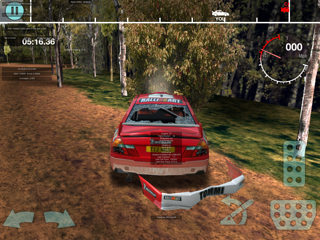 This small project was especially fun for me because it involved leading all aspects of the audio work, from design through game programming as well as runtime tech, while still able to draw on the expertise of the large sound design team at Codies. The resultant game uses fewer voices and DSP effects than the PS1 original, and deliberately includes many of the same samples, yet sounds a lot richer as these are no longer compressed, taking advantage of the extra RAM available nowadays, and many hifi assets from DiRT, GRID and even a few from the F1 series have found their way into the mobile remix. All four wheels have independent physics, skid, scrub and surface sounds, most apparent if you listen on headphones, and dynamic mix adaptations mean the co-driver pace-notes are clear even if you choose to play the game with your own music from iTunes or similar apps alongside.
The pace notes are exactly as they were in the 30 featured rally stages from massive hit Colin McRae Rally 2, voiced by Colin McRae's co-driver Nicky Grist; in this case many of them are as remixed for Dreamcast and amusement arcade versions of Colin McRae Rally which did not see release at the time but cut through very well on modern mobile platforms.
The engine replay system is based on the approach used in DiRT and GRID (pioneered in Race Driver 3) rather than old-school crossfaded loops, and all mixing is performed at 48 KHz rather than the usual Unity Engine/FMOD mobile default of 24 KHz (except on the iPhone 4 version, which is dynamically trimmed to make best use of that relatively slow platform). Crowd and other ambiences owe more to CMR5, as I'd worked on that game to improve those aspects; hundreds of them were carefully placed in-game by a freelance designer Tom McCaren who subsequently and deservedly landed a full time job at Codies.
The producer of Colin McRae Rally for iOS was Pete Harrison, who also took resonsibility for the very successful reworking of Race Driver GRID playing on Sega cabinets in an amusement arcade near you. Pete has a background in audio, having being European Tech Evangelist at Creative Labs a decade before, instrumental in the support for 7.1 surround and advanced CMSS3D headphone support in Colin McRae rally games from CMR4 onward, and the advantages of having an audiophile producer cannot be understated, from my point of view. Listen to the game - it's a couple of quid on the app store - and hear what I mean!
Quick ports of the iOS product I worked on have since been released by various publishers for Android, Blackberry, Apple OS X and Steam PCs.
MicroMachines, iPad/iPhone, Android; Codemasters 2015/2016
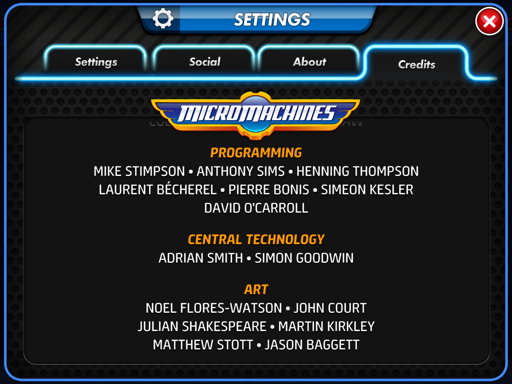
My final Codemasters credit was for work on the Mobile versions of MicroMachines, licensed from Hasbro and published by EA subsidiary Chillingo. The Ego 2.5 engine tech was credited to me and my colleague Adrian Smith in Southam, last men standing in the once 30-strong Central Tech department, with gameplay from a small group in the Birmingham studio which mainly makes Formula 1 games for consoles and PCs.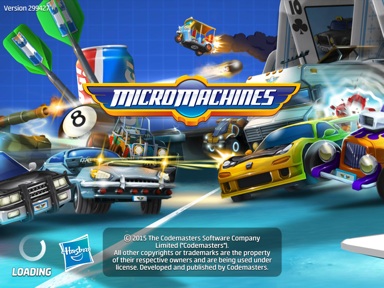 The latest F1 mobile game was outsourced and Ade works on the Colin McRae Rally team now, as CT closed a few days before I left. So I was both the first programmer in Central Tech, and the last. 12 years is not a bad run, especially given the multi-million selling number ones we shipped along the way.
Dean Bilotti deserves strong recognition for the Ego engine mobile rendering systems, though the only credit that hinted at this was for Toybox Turbos, which came out on obsolescent consoles but never surfaced on iOS or Android though we had playable versions of that and several other unreleased titles in-house before he left. It even featured on the retail packaging of the Nvidia Shield console, though sadly not inside (see photo right). Dean reinvigorated CT and played a major role in almost all titles made during the 'dash for mobile' as the department otherwise dwindled. He works for Apple now.

R.I.P. Codemasters Central Tech, 2003-2015
As in any console studio, where high dev budgets are still dwarfed by the product release costs, I worked on many other games lost to licence and investment gambles, console and tech transitions, including: Colin McRae Redline, with awesome audio made with my erstwhile sidekicks Staff Bawler and Jon Michell; Operation Flashpoint Middle East Crisis, the first proposed followup to Bohemia Interactive's PC-only OFP and an early experiment in Ambisonic soundfields with ace designer Ben McCullough, who I'd love to have worked with more; and another transitional rally title for PC and Xbox360, one of three internally labelled 'CMR7' games, prototyped then canned before Neon Engine, Ego and PS3 changed the landscape decisively to make Colin McRae DiRT and RaceDriver Grid possible.But overall the work that shipped more than vindicated Chris Southall's decision to create a new Central Tech department over the ashes of the old Core team (leaders of whom founded Freestyle Games) and to appoint me, an audio specialist, as the first programmer, joining 'white hat hacker' and security specialist Murray Rigluth, who ended up running Sony's DADC plant in Austria. When Chris left for Sega his successor as CTO, Bryan Marshall, now at Nominet, grew the department and made the case to make the new in-house game engines - Neon Engine, then Ego - central to Codies' successes on Playstation 3 and Xbox.
I should also say thank you to the dozens of sound designers and handful of game audio programmers I've worked with at Codemasters. In my role as Principal Programmer (Audio) I was directly answerable to both the Audio Director and the CTO, and indeed hired to bridge those departments and the game team programmers, which had previously sometimes communicated more by dead letter drops than active collaboration. Not only did we get get some great audio tech that way, we also got more technically-adventurous sound designers and greater audio-awareness elsewhere in the company.
I'm especially proud of Dance Factory, which emerged to generate four patents in my name as well as millions of pounds of profits after three years of progressive refinement. Working with Adam Sawkins on that, as well as DiRT and Grid, was exciting and insightful. The Ambisonic mixing tech used in those and subsequent BAFTA-winning titles is arguably my greatest contribution to modern gaming - through 12 million games shipped, grossing half a billion pounds, and demonstrations for the Audio Engineering Society and firms like Audio Kinetic which spread the idea far beyond Codemasters.
Ambisonics is now recognised as crucial to VR and advanced surround in games and other interactive systems, as I gambled it would be at the turn of the millennium when it seemed to be just another failed NRDC project. It was just decades ahead of its time.
No tale of Ambisonics, especially in the UK, should end without a tip of the hat to the Three Doctors of 21st century surround sound, Dave Malham, Richard Furse and Bruce Wiggins; the sonic visionary mathematician and explainer, Michael Gerzon; and Alan Blumlein without whose 1930s inventions we might still be listening to mono discs made of crushed beetles. Like Newton, and Noel Gallagher, I have stood on the shoulders of giants - thank you all.
© Simon N Goodwin, Warwick 2005..2017, and reviewers
Link to the top of this document Link to the article index